My son, Matt, is a personable guy. He is good with people. When we were still running a charter boat, clients routinely told me how much they enjoyed fishing with Matt. In fact, they often asked for Matt when they would rebook.
Now, in his job as a butcher at Mejier’s, he still gets to interact with people. The same customers come in every week to get groceries, and they typically stop at the meat counter and ask if Matt is in. They might have a special request, and he makes sure their order is trimmed and packed just right. Their conversation often turns somehow to hunting.
An elderly lady will share that the cornfield on their 100-acre farm has just been harvested, and there are hundreds of geese in it. “Do you let anyone hunt?” Matt will ask.
“Well, not normally,” she’ll reply, “But you can hunt it.” Granted, Matt has an advantage and a captive audience, but hunters can use the same persistence, consideration, and friendliness to get permission to hunt.
Avoid requesting permission the day before you’re hoping or planning to hunt or during the hunting season. You’re too late. Others are likely to have been there long before you. Farmers and ranchers are busy in the fall. They’re out on their properties from daylight to dark come harvest time, and it’s not a good time to catch them, interrupt, or bother them. Getting permission is like a crop that you must cultivate.
Late summer is a better time to ask for permission, but your quest can begin in winter when people are more likely to be home. Of course, there are exceptions, like when you’re going to a different state to hunt. Locally, making contact in the winter is like planting a seed, and people will remember you when you come back later in the year. It also shows that you value the landowner’s time.

- If you plan to hunt on land you’ve hunted before, call the landowner in advance to let them know your hunting plans and confirm it’s OK to hunt.
An app like On X Hunt, or similar apps, can provide valuable insights into the property’s exact dimensions, ownership, and contact information. Often, you’ll find absentee landowners, and the app provides a starting point to begin your quest. When talking directly with the landowner, pull up the app on your phone to review the exact dimensions of the field or marsh you’re hunting, and ensure the landowner understands your intentions and desires. Doing so may even lead to other opportunities. The landowner may share with you that he’s planning on cutting the adjacent 200-acre cornfield next week, and once they’re done, you can hunt it.
If you plan to hunt on land you’ve hunted before, call the landowner in advance to let them know your hunting plans and confirm it’s OK to hunt. Doing so can save you some time and effort. We made friends with a landowner in North Dakota who has let us hunt in the past. Matt contacted him a few weeks before we planned to come out hunting, and he informed us that his son and some friends were going to be deer hunting on the property that week.
Waterfowl hunters are finding it increasingly difficult to get permission to hunt due to the surge in archery deer hunters. With exceptionally high deer numbers, advances in archery technology, like crossbows, and hunters with more leisure time, archery deer hunting has exploded. Landowners are less inclined to grant permission to hunt a cut cornfield or an adjacent wheat field because they believe it will spook the deer or interfere with their patterns. You might luck out and get to hunt a property after deer season or for early-season geese in September before archery season starts.
Put your best face on when you go to ask permission. Make a good first impression. Avoid wearing your hunting clothing or your dirty work clothes when knocking on the door. If you’re going to be hunting with your kids, take them along. Doing so shows you’re a responsible adult and parent, and landowners might appreciate the fact that you’re exposing them to hunting.
Persistence pays off. Don’t make yourself an annoyance, but a follow-up contact, even if the landowner originally told you no, can pay dividends. Things change. The land may have changed ownership. The grandson who used to hunt may be off to college. The ornery cuss that told you no might have passed, and his wife might be more open to letting you hunt. Repeated contact, short of being an annoyance, can show landowners you’re serious, responsible, and friendly.
Remember that you’re asking to use a firearm on someone’s private property. There are risks for the landowner. Offer to sign a liability waiver. It will set the landowner’s mind at ease and show that you’re a responsible individual. Inform the landowner of your exact hunting plans, including the number of hunters and a description of the vehicles they can expect to see on the property. Make sure it’s OK to drive in the fields. Farmers and ranchers may not want you driving in the field if it’s wet and there’s a chance of getting stuck. Then the only alternative might be to go to the property owner, hat in hand, and ask him to pull you out.
In some parts of the country, such as North Dakota, the odds are good for getting access to private ground by asking permission from landowners. In North Dakota, private property can be delineated with no trespassing signs at the corners of the property, which can be a considerable distance apart. More properties are being e-posted online. You can see which properties are e-posted on the North Dakota Game & Fish website. In North Dakota, if the land isn’t posted, it is technically open to hunting. Even so, asking for permission is a good idea anyway. In Kansas, if a fence post or stone at the corner is painted purple, the land is off-limits to hunting. Make sure you’re aware of the rules and regulations of any state you plan on hunting. It’s a good idea to sit down with your hunting party and read the hunting regulations from cover to cover, even if you’ve hunted there before. Things change.
Following up with the landowner after the season or in the winter to thank them for giving you the opportunity to hunt is wise and just common sense. Offer to share some of the game you harvested. Matt, being a butcher, often takes the landowner a nice package of steaks. Some people believe that simply throwing money at the landowner is just as effective, but it’s impersonal and sets a dangerous precedent. Once one guy starts dropping large sums of cash for permission to hunt, it starts a chain reaction that shuts out most hunters.
You’re much better off offering some vegetables from the garden, some homemade jam or preserves, smoked fish from your successful summer trips, or jerky or sausage you made from the geese you shot on the landowner’s property. To many, it means more than money.
We always bring some Michigan-themed items on our out-of-state trips. People love crisp Michigan apples, maple syrup, and smoked salmon.
On one of our trips to Saskatchewan, we were driving back roads, and a flock of Hungarian partridge ran across the road. There wasn’t a dwelling in any direction for 20 miles. We decided to jump out and see if we couldn’t flush the huns.
After collecting several of the gray partridges, we saw a tractor coming over the horizon. We waited until the farmer got close, turned the tractor off, and hopped down.
We exchanged pleasantries. “You boys hunting birds?” the farmers asked.
“Yep,” I replied. “We saw a flock fly across the road and thought we’d see if we could flush them up.”
“You kill any?” he asked.
“Ya, we managed to get three,” I responded.
“Good!” he said. “I just saw another flock about a ¼ mile in that direction,” he pointed back down the road. You’re more than welcome to hunt them.
“How much property do you farm?” I asked.
“Well, if you go about six miles in that direction,” he said, turning and gesturing over his left shoulder, “I farm all that. You’re more than welcome to hunt it.”
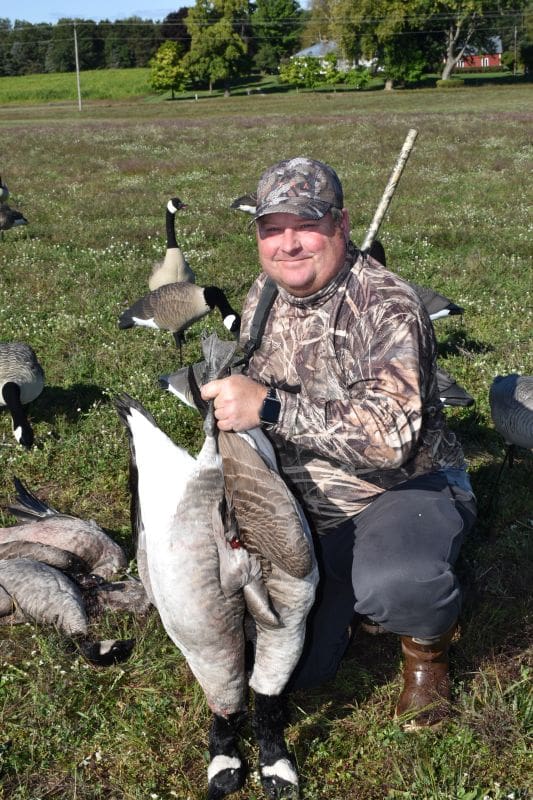
- Making contact with the landowner well before the season paid big dividends for Sean McDonald.
Grateful for the kindness and opportunity, I said, “Would you like to try some smoked salmon?
That evening, we returned to the hotel we were staying at in Imperial, Saskatchewan. The hotel had seen its better days. It had rooms upstairs and a dining area and bar on the lower level. It was steak night, and most of the local population was there to partake. Sounds of cajoling and laughing permeated the air as we pulled our chairs up to a table.
A cluster of farmers and their helpers at the table next to us acknowledged us, and we returned the greeting. Obviously, we were there hunting and not part of the local crowd. One of the farmers asked, “So where are you guys from?”
“Michigan,” I replied.
A huge grin came over his face, and he said, “You’re the guys with the smoked salmon!!!” he exclaimed. “I‘ve got probably 10,000 geese on my property right now. You’re more than welcome to come and hunt them.”
Saskatchewan has something called municipality maps, like plat books in the United States. They show who owns what. Comparing the map to places where we’d been seeing ducks and geese, the name Trevor Lweis kept popping up. We decided to try to contact Trevor Lewis to see if we could hunt the properties. We found a number in the local phone book and contacted Trevor.
“Yeah, I might be willing to let you hunt, but I like to meet the people I’m giving permission to first,” he said. He gave us his address, and we made arrangements to meet later that evening.
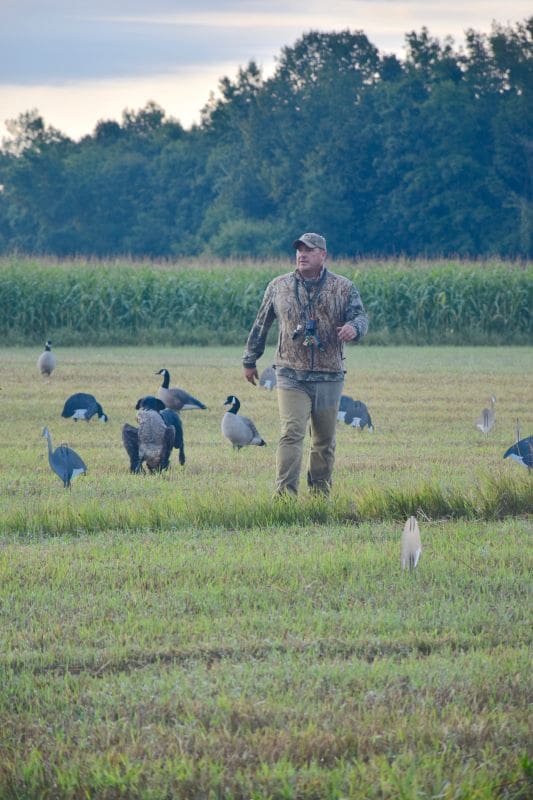
- The opportunity to obtain permission to hunt early-season geese before the archery deer season begins is possible.
Armed with a case of Molson, Michigan apples, and smoked salmon, we knocked on the door. His wife answered and called for Trevor. He was much younger than we expected and not one of those grizzled, weathered, tanned farmers you typically run into on the Canadian Prairies.
We exchanged pleasantries, told him where we were from, and offered our gifts. We explained where we’d been seeing geese and the fact that his name was on the properties we were looking to hunt. We talked about the price of wheat, how the harvest was progressing, and the weather.
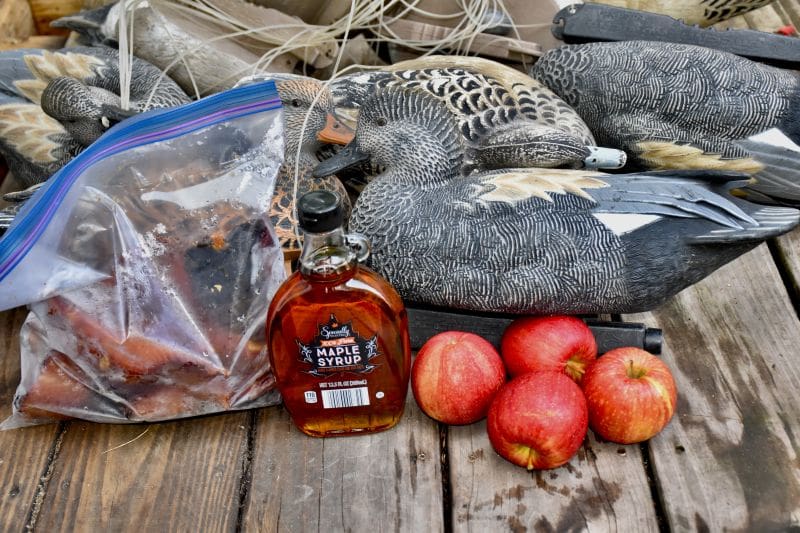
- Returning to thank property owners who let you hunt is only common sense. Gifts, like maple syrup and smoked salmon, are often more appreciated by landowners than cash.
After about 20 minutes, Trevor said,” I like you guys. You can hunt anything that says Lewis on it.”
Extremely happy, we said, “Can you give us some idea of the property boundaries and what you own?” “Well,” he said, gently rubbing his chin, “Some folks accuse me of being a land hog, but you’ve got to do what you’ve got to do. I basically farm the surrounding 37 square miles, and you are welcome to hunt it all.”
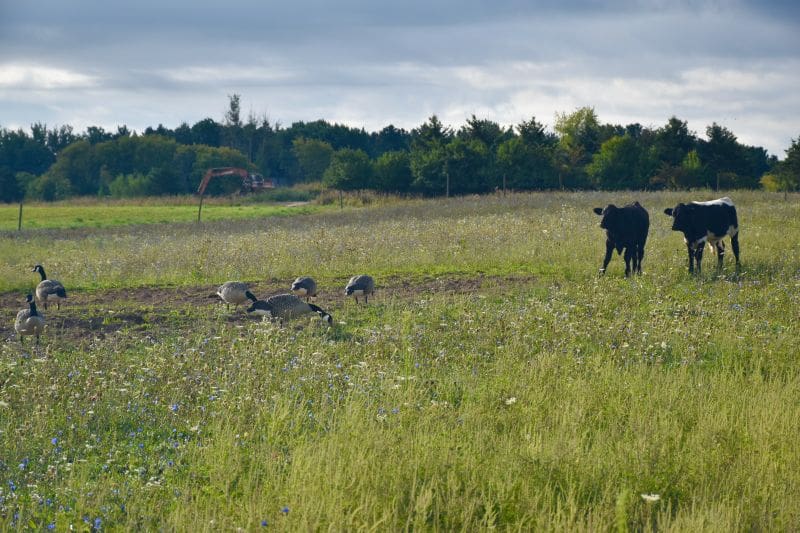
- Make sure you’re well aware of properties and give livestock a wide berth.