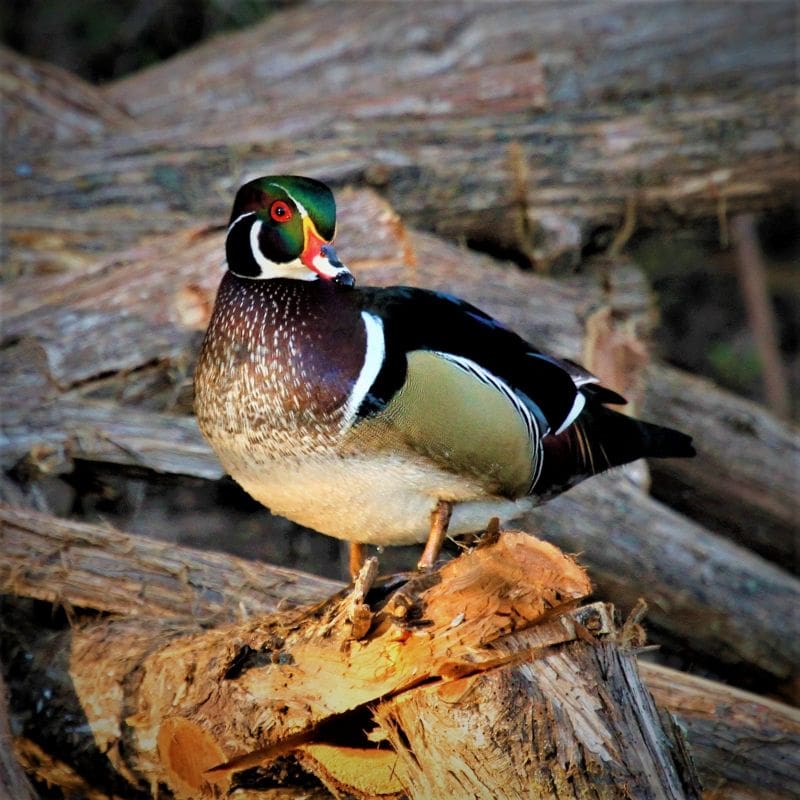
The comeback of the wood duck rivals any conversation story in history. The fact that wood ducks have rebounded to historic levels is reminiscent of the revivals of white-tailed deer and Eastern Wild Turkey.
Two factors, marketing hunting and habitat destruction, caused the wood duck’s initial decline. Few realize it, but wood ducks were among the most heavily harvested birds by market hunters. Common across eastern North America, where the bulk of the human population resided, wood ducks were hunted eight months of the year until 1918, when the Migratory Bird Treaty Act was passed.
Without the relentless hunting pressure, wood duck numbers began to recover, and suitable habitat was available to facilitate the comeback. Unchecked clear-cutting of the landscape during the 1800s and early 1900s spared bottomlands that were annually flooded along the gnarly river floodplains and sloughs. It was precisely the type of habitat in which wood ducks thrived.
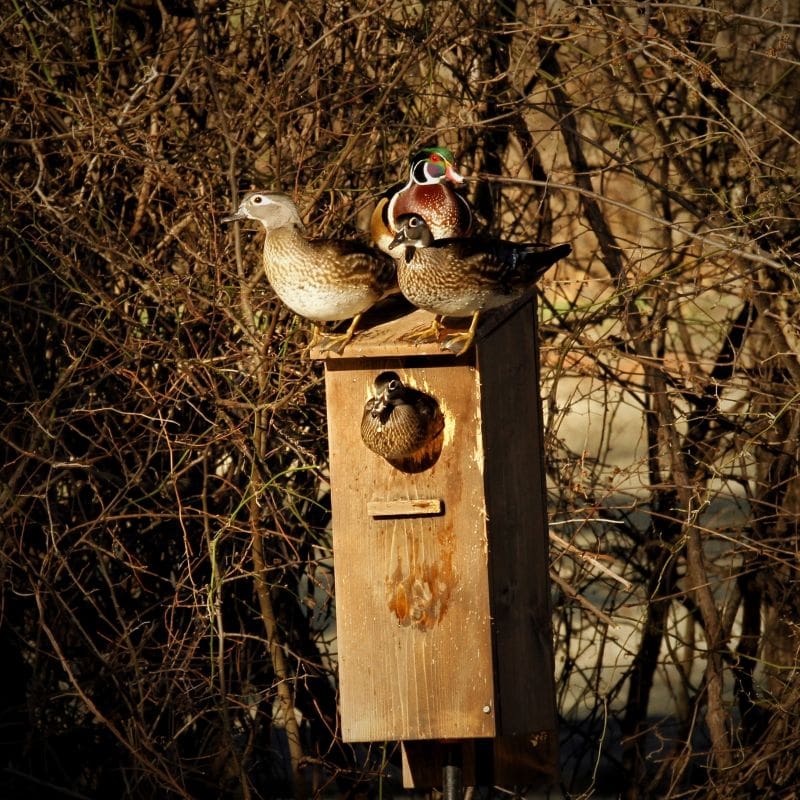
- Wood ducks are gregarious and not above parasitizing another’s nest or box. Wood ducks usually return to the same nesting site year after year, barring any catastrophic event.
Unlike other ducks, it’s hard to estimate precisely how many wood ducks there are because of the habitat they prefer. Estimating wood duck populations by aircraft is nearly impossible due to the forested habitat and the thick vegetation in which they nest. Biologists rely on four main tools for estimating wood duck populations:
1) The annual Breeding Bird Survey (BBS)
2) Monitoring of nesting boxes
3) Examining wings from harvested birds at annual Wing Bees
4) Recovery of leg bands and hunter harvest surveys
Wood duck populations continue to increase and expand even though bottomlands are still being drained and cleared at an alarming rate. The maturation of the country’s forests has helped wood ducks. The history of forestry from 1870 to 1930 was to clear-cut harvest every single tree. Now the industry practices selective harvest, and since about 1950, the number of cavities in 12-inch or large trees has increased exponentially. There are lots of nesting cavities available to wood ducks and other cavity nesters now that we have an abundance of trees maturing. Wood ducks are more terrestrial than any other duck. It’s not uncommon for a wood duck to nest one or two miles from wetland habitat if they can find a suitable nesting cavity. It can be a peerless journey for the brood, but a large percentage of the ducklings make it.
I remember turkey hunting many years ago, setting up against a grove of mature beech trees. I enjoyed watching a pair of woodies come and go from a cavity in one tree. The nesting site was a good mile from the river, but I’d bet the ducklings survived the journey.
Nesting boxes are nothing new. Concerned conservationists began placing nesting boxes along the Illinois River in the 1930s, but it wasn’t until the last couple of decades that building nesting boxes became a popular activity for Boy Scout troops, conservation clubs, and concerned property owners, and wood ducks have responded accordingly.
A college bud has done very well for himself. Besides a spacious cottage on the White River in Arkansas, he has a palatial estate near Edmond, Oklahoma. The property has several ponds. After seeing a few wood ducks around the ponds, he decided to put up a couple of wood duck houses to gauge interest. The first year, the two houses went unoccupied, but a couple of ducks showed interest. The following year, both boxes were occupied, so he added a couple more, which quickly found more feathery squatters. More boxes were added, bringing the total to 11. All were in use this past spring.
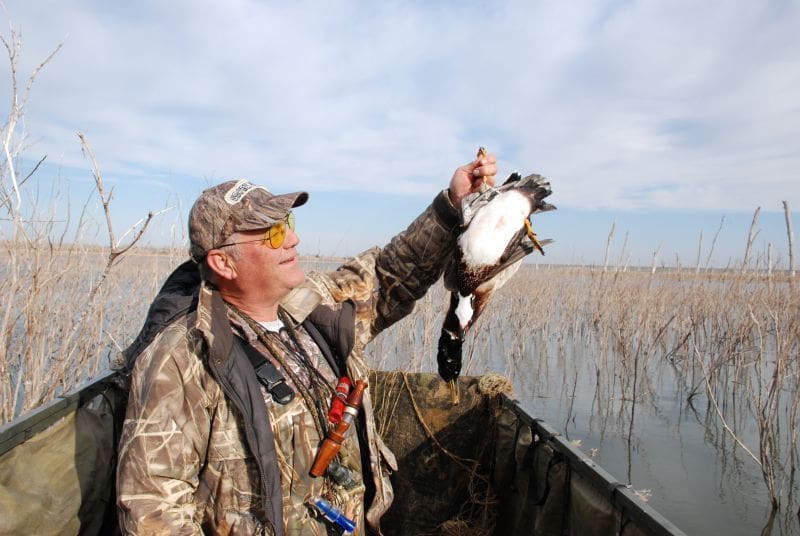
- Wood ducks make up an increasingly larger portion of many waterfowlers’ bags.
Experts advise against putting boxes too close together, but Buskirk said his boxes are relatively close and have turned into a communal affair. Many ducks, like redheads, will parasitize the nests of other ducks. Apparently, wood ducks are not above the same shenanigans. One box he looked into with a camera contained more than 30 eggs. Maybe that’s why researchers advise spacing boxes more widely.
Winter is the perfect time to start planning to construct wood duck boxes. You can organize a work bee at the local sportsman’s club to create boxes or work on them in your own garage. Cedar is the best building material because of its natural oils and resiliency. Buskirk built his initial box from 1 x 8-inch boards, but a materials shortage caused him to construct the following boxes from 1 x 10-inch boards. The woodies enjoyed the extra room, and the larger boxes seemed to be more productive.
Once construction is complete, winter is a good time to put the boxes out. Area lakes and marshes will be frozen, allowing easy access. You can use an ice auger to drill holes for posts or attach the boxes to flooded trees. A sled can be used to haul the boxes to the perfect locations. As usual, use caution and make sure ice conditions are safe.
If you already have wood duck houses out, winter is a good time to check their condition and clean them out to greet spring visitors. Clear old debris from the boxes and replace it with a few inches of wood shavings.
Wood ducks are extremely philopatric, meaning they tend to return to the exact breeding location each year. Experts will tell you nesting boxes are preferred over natural cavities in many cases. There’s little doubt that nesting boxes have helped the wood duck population flourish.

- Aptly nicknamed “summer ducks,” wood ducks leave the northern climes, where many of them breed, at the first hint of cold weather.
The Great Lakes Region has an abundance of prime wood duck habitat, and older studies have reported an annual increase in population of between 9 and 16%. That number may be even higher now, thanks to wood duck boxes.