Many waterfowlers prefer hunting ducks over geese because of the variety of species. If you shoot a Canada goose, it’s a Canada goose. There might be some difference in size, but for all practical purposes, it’s going to be colored like a Canada goose with little variation. A snow goose is a snow goose, except when it’s a blue goose.
Ducks, on the other hand, come in all shapes and sizes. From the pink, garish feet of a diminutive drake bufflehead to the kaleidoscope of surreal colors a wood duck sports, to the subtle handsomeness and subtleties of a gadwall, ducks offer the ultimate when it comes to variety.
The variety extends beyond just looks. They behave differently and frequent vastly different habitats. There’s a basic distinction between diving ducks and puddle ducks. Only God knows how all these species evolved, but waterfowlers are thankful they did.
According to researchers and biologists, there are 41 different species of waterfowl found in North America. The list includes puddle ducks, diving ducks, swans, cranes, sea ducks, and several species of geese. Waterfowl typically follow loosely defined migration routes called flyways, but not always. Species that are not common in North America often get blown off course or inhabit an isolated part of the continent, and are not generally encountered by the average waterfowl, but show up in the harvest every year. Some of these species include Eurasian widgeon and teal, Tufted ducks, Mexican ducks, white-cheeked pintail, Barnacle geese, and various hybrids. Though rarely harvested by North American waterfowlers and not considered among the core species, the oddball species show up in some lucky hunter’s bag every year.
Hunters who seek to harvest all 41 North American waterfowl species face a daunting challenge and a sizeable investment of time, money, and effort. But it’s not much different than those who undertake to harvest a Big Game Super Slam or turkey zealots who endeavor to undertake the Turkey Grand Slam. In some ways, accomplishing the North American Waterfowl Slam may be more difficult than completing either of the other slams. One reason is that there are many more components.
The good news is that many of the birds in the challenge can be harvested where you normally hunt, or by making an excursion to nearby states you can drive to. If you happen to live near the Great Lakes, there are outstanding opportunities to harvest multiple species of puddle ducks, diving ducks, and geese. A foray to North Dakota or Missouri is likely to add several of the species you’re not likely to see around the Great Lakes. These days, harvesting a couple of the scoter species and long-tailed ducks or old squaws is not difficult on the Great Lakes, but you may still need to make a trip to Cape Cod to check off a brant or the scoter species.
Most diehard waterfowlers can knock off close to 30 species available in North America on their own. It’s the other 10 or 12 that many require some doing.
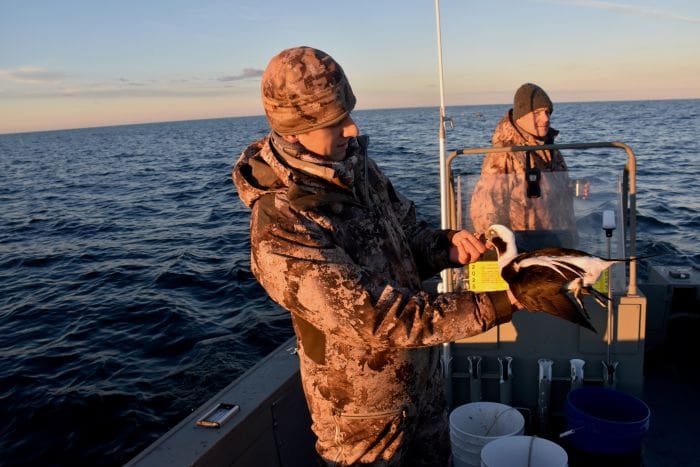
Jim Riley (406-580-4036; waterfowlerschallenge.com), owner of the Ultimate Waterfowl Challenge, created a system to aid, certify, and record every species of waterfowl harvested over your career, and verify each species on the UWC website. As part of the challenge, for all waterfowl other than geese, Tundra swans, Sandhill cranes, black ducks, and mottled ducks, only drakes are counted to be entered to certify a species. The defining goal is to legally and ethically harvest each of the recognized species of North American waterfowl over the course of your hunting career. Participants in the UMC can grandfather up to three species on their list, subject to certain qualifications. Members can achieve certain levels as they harvest birds towards the definitive goal- the Ultimate Waterfowler’s Challenge.

Airboats got hunters out in the playas of Mexico
To qualify requires a clear close-up photo of the bird on its stomach, showing the side of the bird’s head, wings extended, with the participant’s waterfowl ID card placed directly below the bird’s bill. A fee is required to enter the birds in the challenge, depending on the member’s status.
To be honest, the process is involved and daunting; there are numerous rules, details, hurdles, and qualifications to meet, so aspiring waterfowlers should review the website carefully before undertaking the challenge. In the end, shooting the birds might be the easy part.
When Jim Riley was asked how many hunters accomplish the Ultimate Waterfowl Challenge, he responded, “More than you’d think. We’ve had a few as young as 16 complete the challenge, and it’s common to have young hunters in their 20s complete the feat. On the other end of the scale, older guys on their deathbeds have gotten their last bird just before they died.”
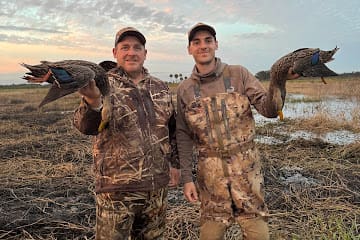
Mike (l) and Landon Smith with exquisite examples of a Mottled duck.
Riley said most hunters can harvest most waterfowl that count towards the challenge on their own, but a few are difficult because of the cost of getting to where they live or the need to draw a permit. For the most difficult species to harvest, the Ultimate Waterfowlers Challenge partners with a cadre of reputable outfitters in places like Alaska, Mexico, Florida, Newfoundland, and the East Coast, where waterfowlers can cross off the most difficult species from their bucket list.
“One of the most difficult is the King Eider because of the expense and the remote areas in Alaska that you need to get to in order to hunt them,” said Riley. “Other species that are difficult to check off the list include the Tundra Swan, because of the need to draw a permit to shoot one, and, surprisingly, the common and red-breasted merganser.”
Friends Landon and Mike Smith accepted the Ultimate Waterfowl Challenge back in 2022. “Landon came to me and said, “Look at this,” said Mike Smith. “We agreed that it would be really cool to accomplish something like that, but the time and expense of trying to collect all the birds would be costly, in both time and money. But the more I thought about it, the more I questioned how much time Landon and I had left to hunt together. I’m no spring chicken, and Landon would be finished with school and off on his own soon, so we decided to undertake the challenge. It was one of the best things I’ve ever done.”
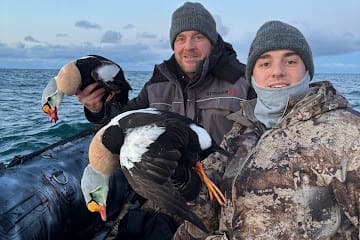
King Eiders are considered one of the most beautiful of waterfowl and one of the most difficult to harvest.
Smith said they decided to start with a clean slate. Although they had already harvested many of the species required to complete the challenge, they chose not to grandfather in any birds.
Their home state of Michigan provides a multitude of waterfowl opportunities. The Wolverine State’s expansive marshes, bountiful lakes, and estuaries attract a variety of both puddle ducks and diving ducks. In recent years, the number of sea ducks on the Great Lakes has exploded exponentially, so there’s no need to travel to Alaska to harvest an old squaw.
Annual fall trips to Arkansas, Missouri, North Dakota, and South Dakota added species like widgeon, pintail, and gadwall to the challenge list. Collecting the other species would require travel and sizeable expenditures.
“The places we had to go to in order to collect the last birds are places that we would have never hunted,” said Mike Smith. “It was a treat to see new places and meet new people, sample the local cuisine. If we hadn’t decided to take up the challenge, we would have never done that. And the fact that I got to do it with Landon is special.”
“The trips typically run $4,000 or more per person, and then you have tips plus airfare, so it’s not cheap,” said Mike Smith. “Heck, the airfare just from Anchorage to St. Paul’s Islands was $1,900 per person! Recent travels in pursuit of the Ultimate Waterfowl Challenge have taken the pair to the Bering Sea, St. Paul Island, Alaska, Florida, Cape Cod, and, most recently, Mazatlán near Sinaloa. The trips to distant destinations take place in the winter, which fits well into the Smiths’ fall hunting schedule.
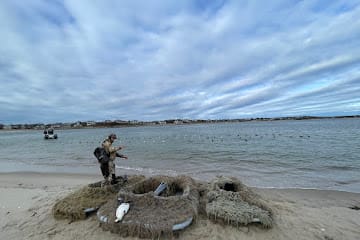
Layouts anchored in front of 10-million-dollar homes made for a surreal environment and hunting experience.
“We decided we could probably do a more expensive trip every other year. We could have done a trip like the one in Cape Cod ourselves. We have a big lake diver rig, but the time spent driving there, combined with the fact that you’d have several days into scouting in order to find the birds, not to mention weather issues, it’s just cheaper and wiser to go with an outfitter or guide,” he said. “It was money well spent.”
“The Cape Cod trip was surreal because you were hunting out of grassed-in layout boats right in front of 10-million-dollar homes,” reminisced Landon Smith. “The guide told me I was the only hunter to shoot a brant, black duck, and all three scoter species in the same day. And he brant ended up being banded. Plus, we got to gorge on lobster!”
“We lucked out on the trip to Alaska because the folks at UWC had a cancellation that we were able to take advantage of,” said Mike Smith. “The trip to the Bering Sea and St. Paul was the most beautiful in terms of scenery and the most challenging in terms of weather. A drake King Eider is the most spectacularly colored waterfowl I’ve ever seen. A drake shoveler or cinnamon teal would be a close second.”
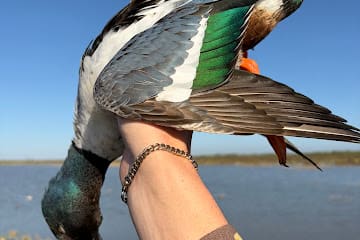
Drake shovelers in their plumage are spectacular.
Hunting on St. Paul Island is brutally simple. “We’re hunting from Zodiacs along the rocks,” said Landon. “We didn’t need to put out many decoys. There was a constant stream of King eiders, Harlequin ducks, common scoters, and old squaws.”
“I would say the Mexico trip was the most fun,” said Landon Smith. “I would put it right up there with the Alaska trip, being a close second. Mexico was the total package- weather, birds, food, guides. It was spectacular.”
Most waterfowlers associate Mexico with desert, but there are expansive shallow, marshy playas that host millions of waterfowl every winter. According to Britannica, “playas are a flat-bottom depression found in interior desert basins and adjacent to coasts within arid and semiarid regions, periodically covered by water that slowly filtrates into the groundwater system or evaporates into the atmosphere, causing the deposition of salt, sand, and mud along the bottom and around the edges of the depression.”
“Every day we headed out at daylight for about a five-mile run in any given direction through the marsh,” said Landon Smith. “When we stopped, there would be clouds of ducks in the air, but only one kind. One morning, we’d see 5,000 pintails, the next day, it would be all shovelers or teal.” The main target of the trip was to collect a drake cinnamon and blue-winged teal. There were a couple of mornings when the harvest included stunning drake examples of green-wing, blue-wing, and cinnamon teal, plus fulvous and whistling tree ducks.
A typical day began at 4 am and breakfast at the lodge at 5 am. After a light breakfast, they’d head to the marsh, rarely hunting later than 10:15 am. A 1:00 pm brunch preceded an afternoon dove or duck hunt. Their rented Benelli Montefalco shotgun didn’t have much time to cool off.
The Smiths now have the list for accomplishing the UWC whittled down to a few birds. “I’m planning on taking our big-lake rig to the east side of Lake St. Clair in Canada this fall, in hopes of knocking off a canvasback and greater scaup off the list,” said Mike Smith. “The others will be a little more difficult. To harvest a Tundra swan, we need to draw a permit in North Dakota or North Carolina. A Barrow’s goldeneye is probably going to require a late-season trip to the West Coast in Oregon or Washington. Sandhill cranes are common in Texas, Oklahoma, and North Dakota. Who knows, we may be able to shoot a crane in Wisconsin this fall. Ironically, the two hardest birds yet to collect might be a common and red-breasted merganser.”
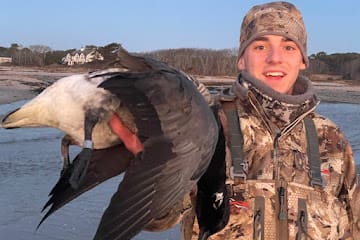
Landon Smith’s first brant also happened to be branded