Flock
They land at the front
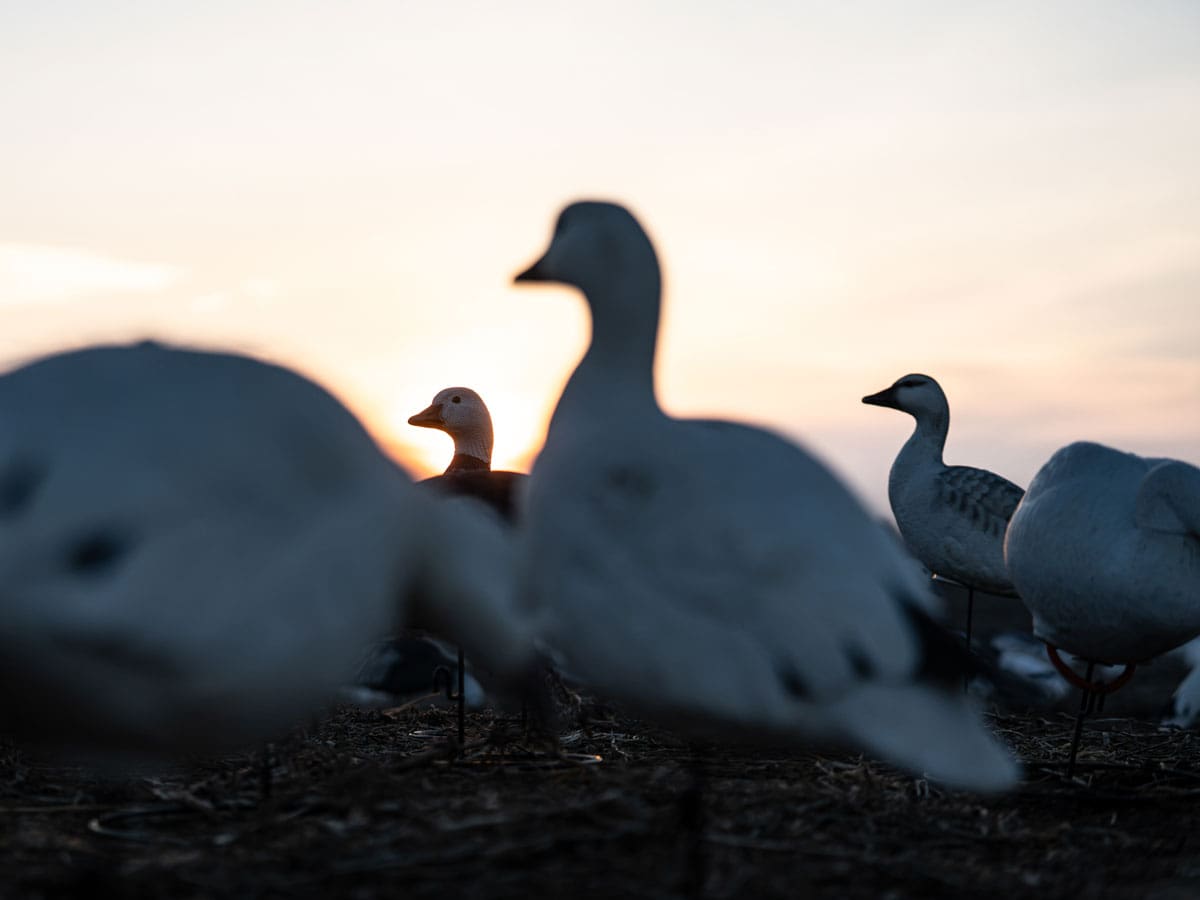
Snows are aggressive feeders, and every bird wants the front of the feeding line. Incoming flocks land upwind of the birds already on the ground. That's where your hide goes.

Spring Conservation Order · Fall migration · Snows, blues and Ross's
Snow goose hunting means big flocks, long days and birds that have been hunted since they left the Arctic. Here's how light geese move in spring and fall, four full body spreads that finish them, and the Hardcore™ snow decoys built to be set, pulled and hauled all season.
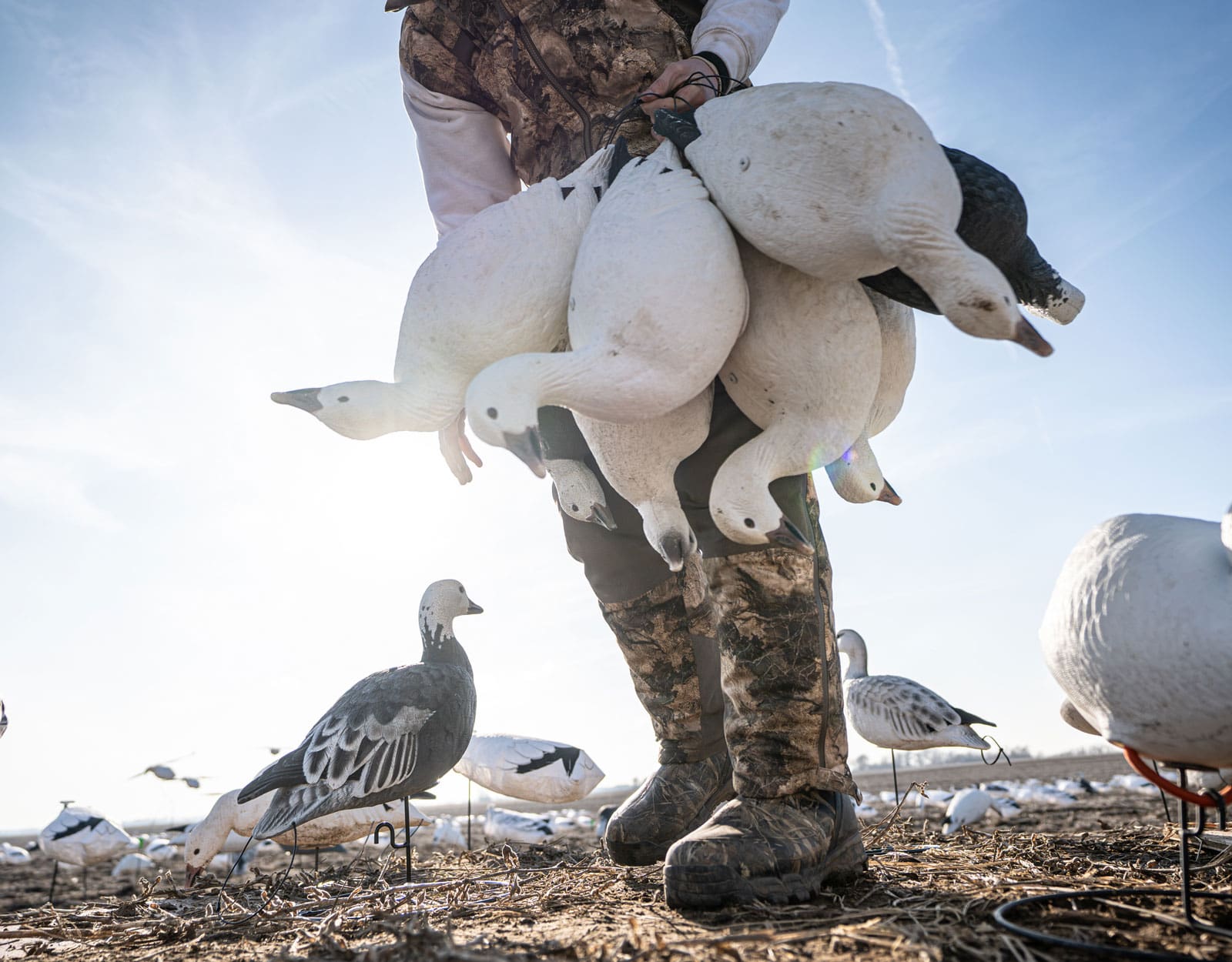
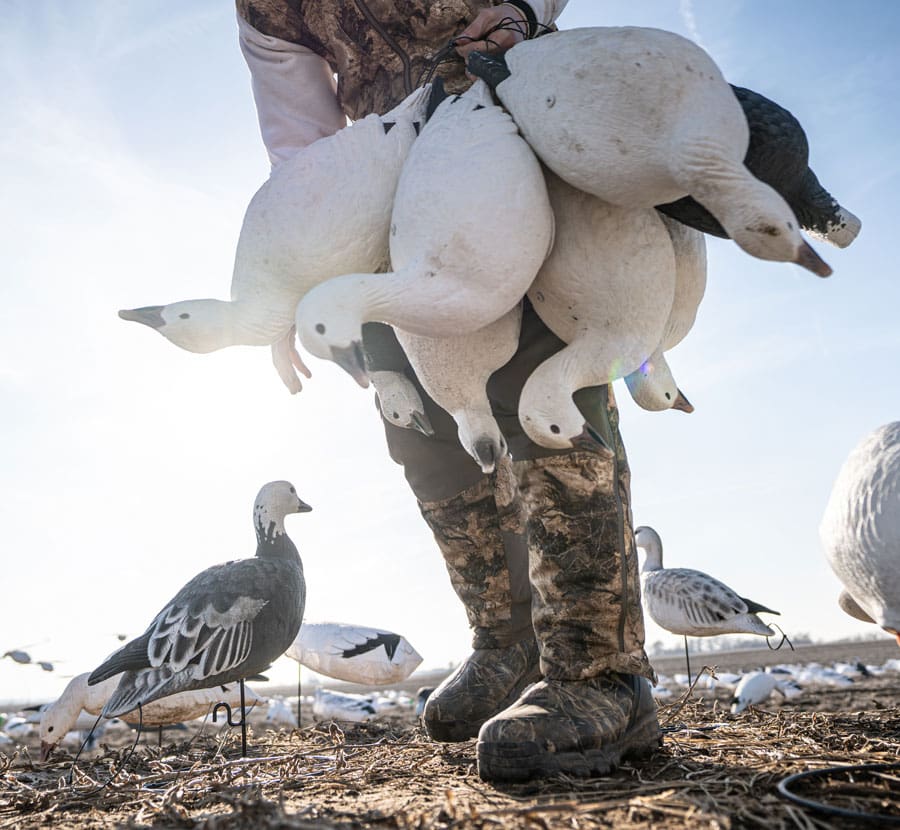
Up to 20% off decoys
Bulk pricing on 10 or more of the same pack.
Try one, ships free
Snow full body single, $24.99.
Free shipping over $399
Continental US only.
FowlFlex™ Rugged Series
In every snow decoy we make.
Know the bird
By the time the Conservation Order opens, snow geese have been hunted since they left the Arctic last fall. They move in huge flocks, they land where the feeding is, and the adults have watched a lot of decoys go by. The hunters who do well hunt the young birds, hide better than they think they need to, and set a spread that looks like a real feed.
1999
The year the Light Goose Conservation Order started, to bring down light goose numbers that were damaging Arctic breeding habitat.
Source: Ducks Unlimited
1 million+
Light geese that Missouri's Loess Bluffs refuge can hold at one time during spring staging.
Source: Ducks Unlimited
300 yds
How far away a bare pink face shows to a flock overhead. Cover it.
Source: Ducks Unlimited
Flock
Snows are aggressive feeders, and every bird wants the front of the feeding line. Incoming flocks land upwind of the birds already on the ground. That's where your hide goes.
Age
Young birds decoy a lot easier than adults. In spring the adults push north fast to reach the nesting grounds, and the juveniles follow on a more relaxed schedule. That's why later flights often hunt better.
Pressure
Adults that have seen a season of spreads tend to hang up at 50 or 60 yards. Hauling more gear rarely fixes it. A more realistic spread and a better hide usually do.
Hide
Snows fly right over you, so anything that doesn't belong stands out. Wear white, cover your face and stay low. Don't park the whole crew in the thickest part of the spread. Birds that have been hunted all winter know that look.
Timing
Flocks coming up from farther south in the afternoon are tired and hungry, and afternoon hunts can be very good. In fall, snows often go roost to field and feed in the same field morning and evening for days.
Water
Fields close to sheet water or a pond hunt a lot better. In spring, staging flocks sit on big water and wait for the ice and snow up north to go out. Find that water, then find the feed they're flying to from it.

Fall to spring
Snows don't hunt the same in the fall as they do in April. The birds, the pressure and the spread all change as the season goes.
Fall
Snows come south from the Arctic, and a lot of the fall birds have never seen a decoy. They often go roost to field and leave the roost in smaller groups that string out all morning, which is easier to decoy than a spring flock. Set in the flight line between the roost and the feed.
Put out
250 to 300 full bodies, about 20 to 25 dozen, spaced loose over a big footprint.
Early spring
The Conservation Order opens and the flocks start north as the ice and snow go out. The adults move first and fast, and big flocks stack up on staging water. Go big and realistic, hunt the feed near that water, and be ready to move when the birds do.
Put out
Your biggest full body spread, set as a long teardrop, with blues mixed in where they fly.
Late spring
Juveniles move north on a more relaxed schedule than the adults, and they decoy a lot easier. If the birds you're hunting have gotten spooky, cut the spread down and make it look like a few families that just landed.
Put out
3 to 6 dozen of your best full bodies in loose family groups.
Spread setups
Every one of these is full bodies only. Same rules in all four: snows land upwind of the feed, they need an open spot to land in, and they want to see families feeding, not a flock standing at attention.
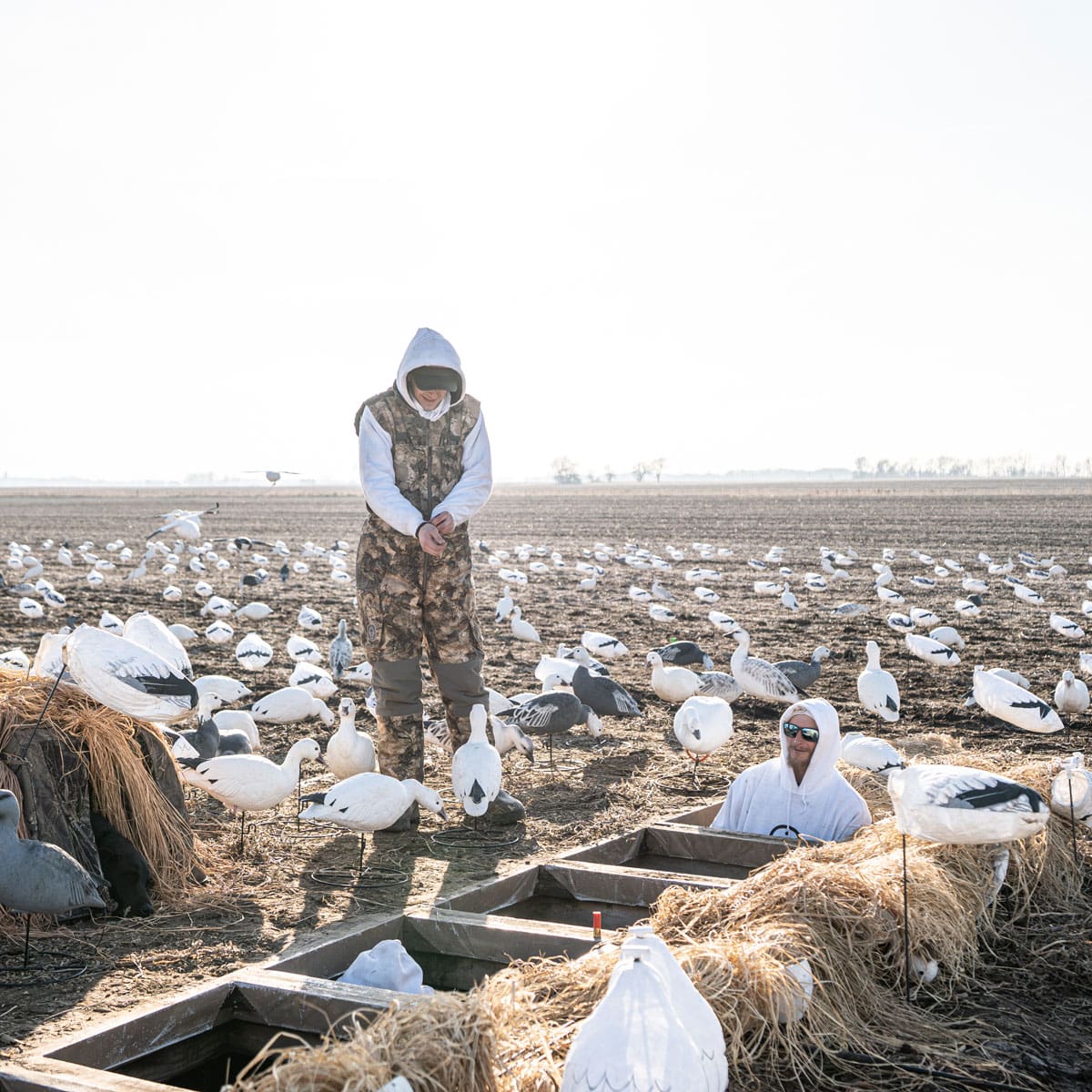
Setup 1
When you've scouted a big feed, go big. One proven spring layout is a long teardrop, wide at the upwind head and strung out downwind in family groups about 10 yards apart. One Missouri outfitter runs it 60 to 80 yards wide and up to 250 yards long. Set the blinds just upwind of the main body so birds follow the feeding line straight to you, and keep the landing zone at the head open.
Twenty Snow and Blue 12-packs is 240 full bodies with 60 blues and 40 juveniles, all at the 20% bulk tier. Add packs as the feed gets bigger.
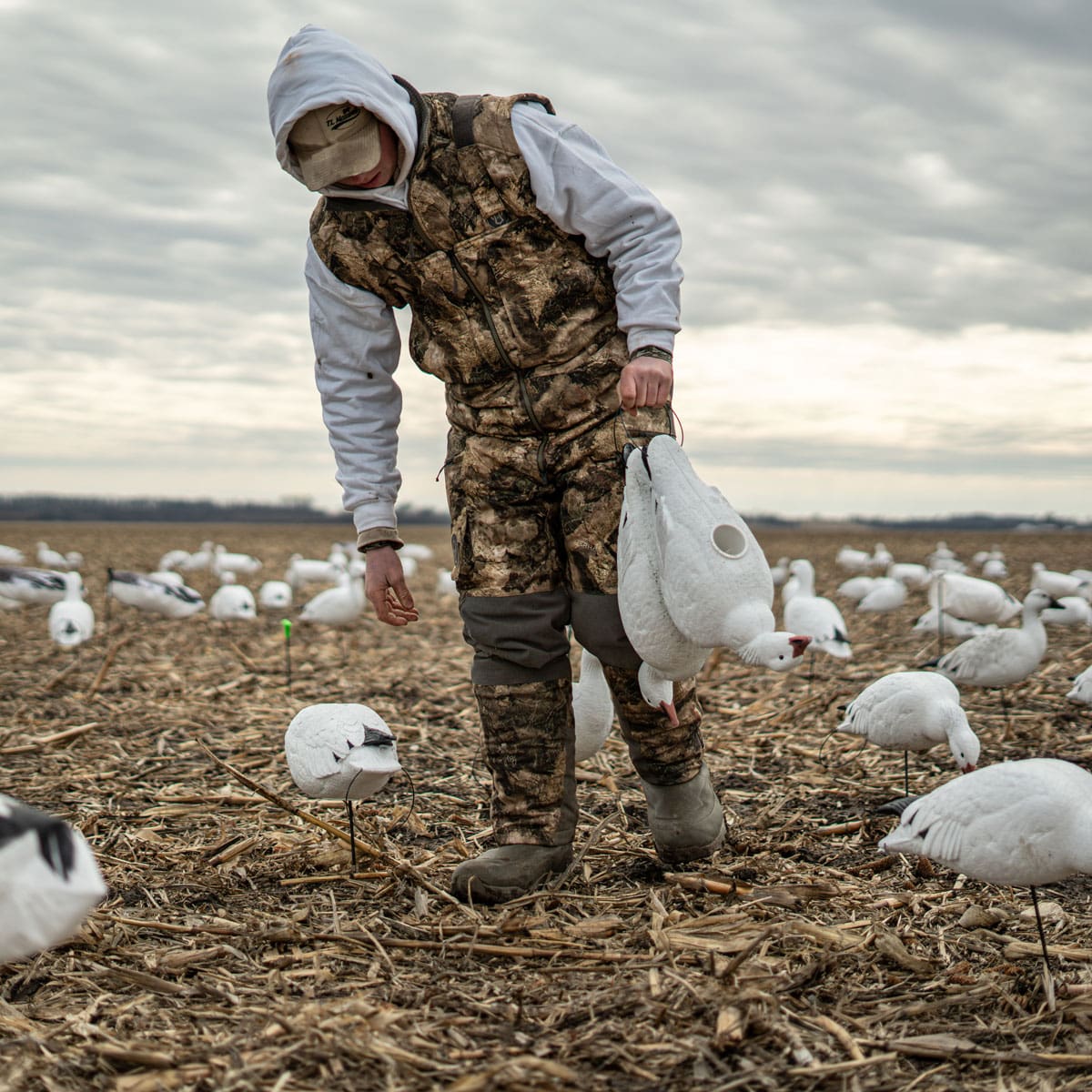
Setup 2
When the birds get spooky, get smaller. One Atlantic Flyway hunter cuts back to three to six dozen of the most realistic decoys he can find once the geese start flaring. Set them loose and random, like a flock that just landed: a feeding line on the upwind edge that trails off in a loose triangle downwind. Hide along a fence line or field edge with the upwind edge about 30 yards out, and pull birds into that gap.
Three to six Snow 12-packs is 36 to 72 full bodies. In the Atlantic Flyway, where few blues show up, stick with the snow-only pack.

Setup 3
Fields next to sheet water or a pond hunt a lot better, and spring flocks stage on water. Set full bodies along the bank and up into the field, then run floaters along the water's edge so the spread reads from both sides. One Illinois pit spread pairs its full bodies with 250 to 300 floaters along the edge. Leave a landing zone about 30 yards across open in front of the hide.
Four Snow Goose Floater 6-packs puts 24 floaters on the water's edge. The WhaleTail™ keel keeps them moving in light current or a light breeze.
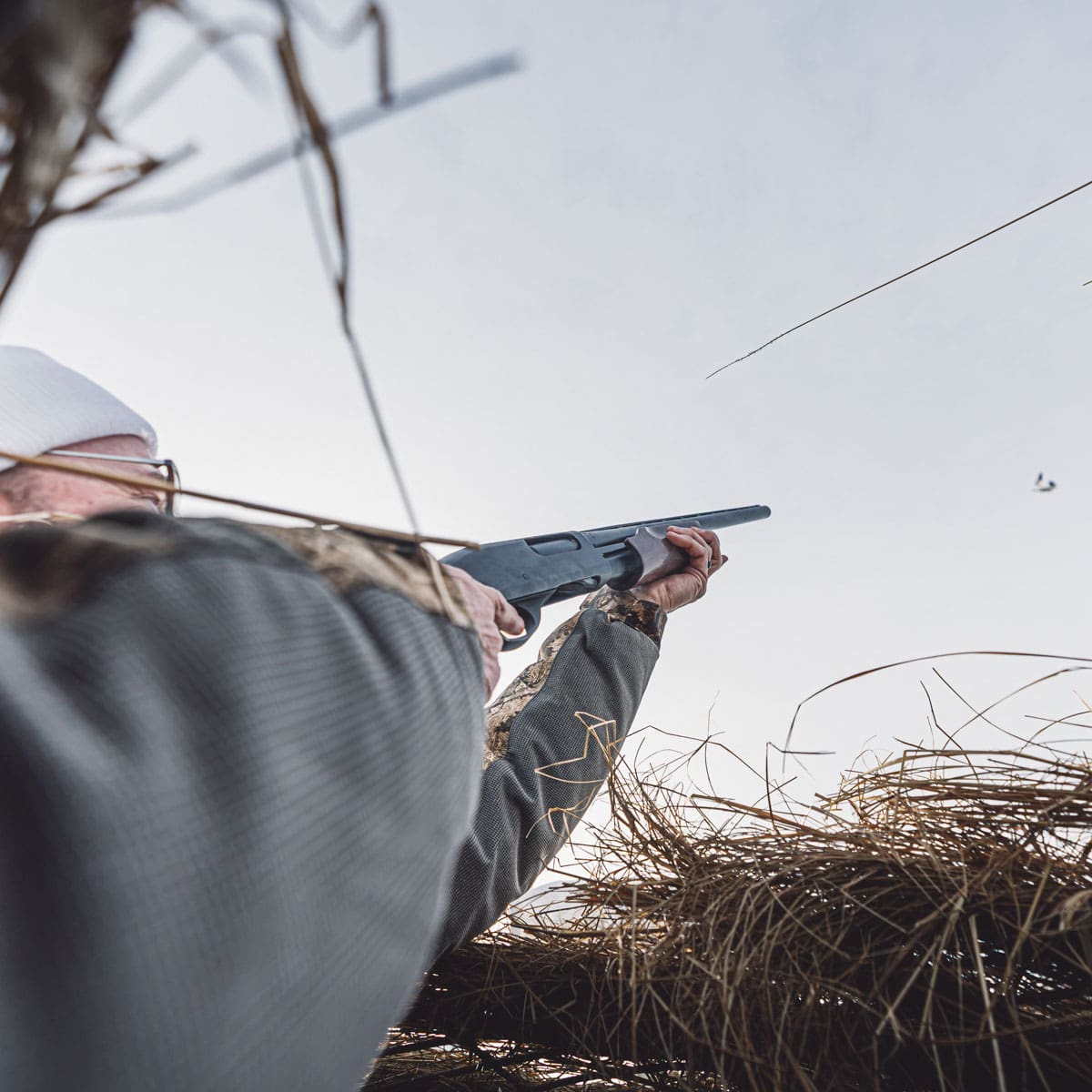
Setup 4
Fall snows often fly the same route from the roost to the feed for days. Instead of trying to outdraw a field full of live birds, set up in the flight line between them and pull birds out of the passing flocks. A Mississippi guide runs 250 to 300 full bodies across about 200 yards, because the spacing makes birds more comfortable and a smaller spread is quicker to set and pull. Clear, cold days with enough wind to center the birds are best.
Twenty-five Snow and Blue 12-packs is 300 full bodies at the 20% bulk tier.
Build the spread
Start with a core of 12-packs, mix in blues where they fly, buy at the bulk tiers, cover the water, and try one first if you're not sure.
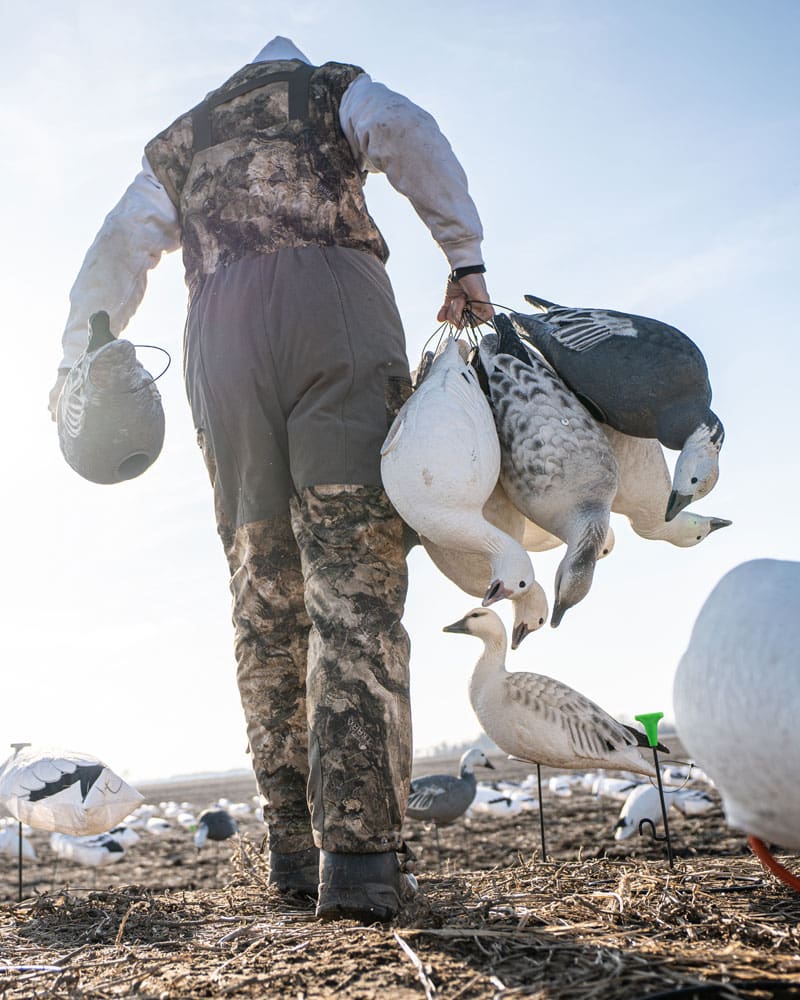
1
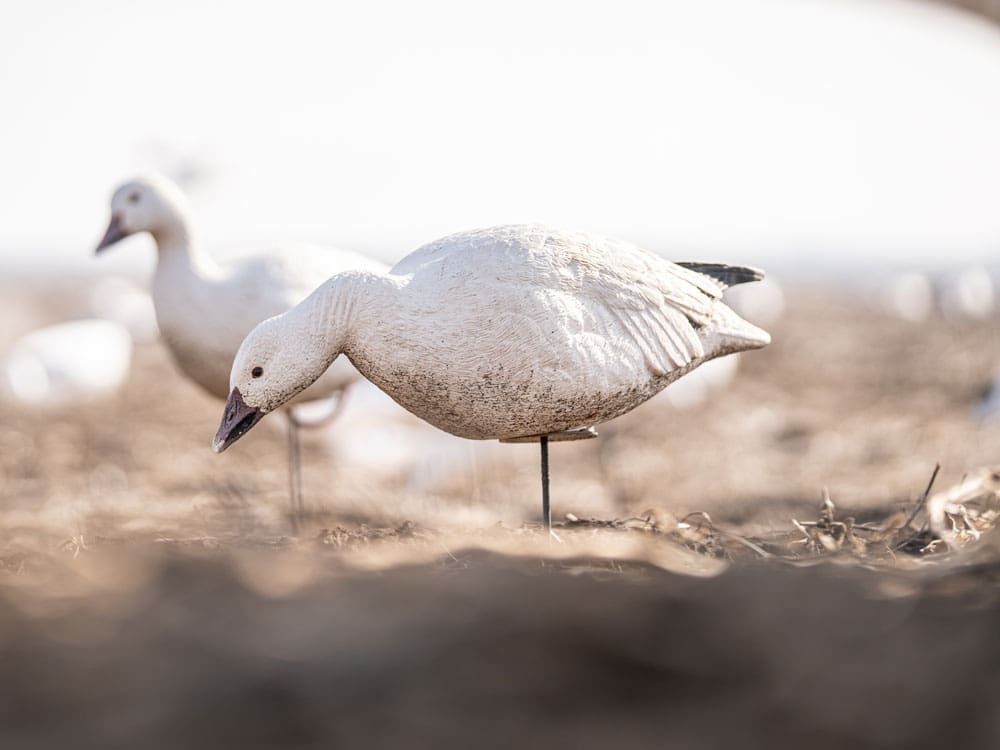
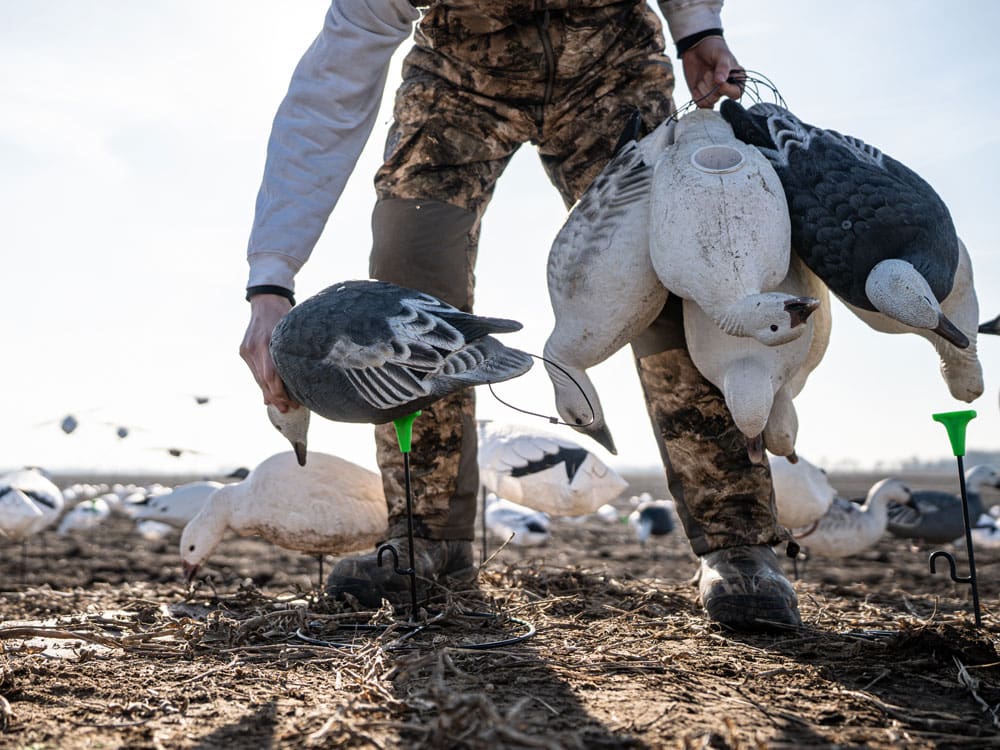
The Full Body Snow Goose Touchdown 12-pack is a feeding family out of the box: 3 actives, 5 straight neck feeders and 4 right turn feeders, with 3 juvenile paint schemes mixed in. Three one-piece poses from 19" to 22", integrated retractable tail loops, and TruMotion™ 2.0 field stakes with a 12" base, 20" tall.
Our most-reviewed snow decoy. 4.8 stars across 56 reviews.
2
The Snow and Blue 12-pack has the same three poses, with 3 adult blues and 2 juveniles in every pack. Mississippi and Central Flyway flocks carry blue-phase birds. In the Atlantic Flyway, where few blues show up, stick with the snow-only pack.
Match the birds you're hunting. 4.8 stars across 49 reviews.
3
Snow spreads run big, so bulk pricing is standing, not a sale. 10 or more of the same 12-pack takes 10% off, and 20 or more takes 20% off. That takes a full body from $23.33 down to $18.67.
It's per pack model. 20 Snow and Blue packs hit the 20% tier. 10 of each pack hits 10% on both.
Bulk tier
20 Snow and Blue 12-packs, 240 full bodies
$4,479.80
$223.99 a pack · save $1,120.00
See volume pricing4
Staging snows sit on water. The Snow Goose Floater 6-pack is six adult snows, two each of an active, a relaxed and a rester pose, 16 7/8" to 17 3/4" long, riding the WhaleTail™ keel so they move with very little current or breeze.
Run them along the water's edge in front of your full bodies.
5
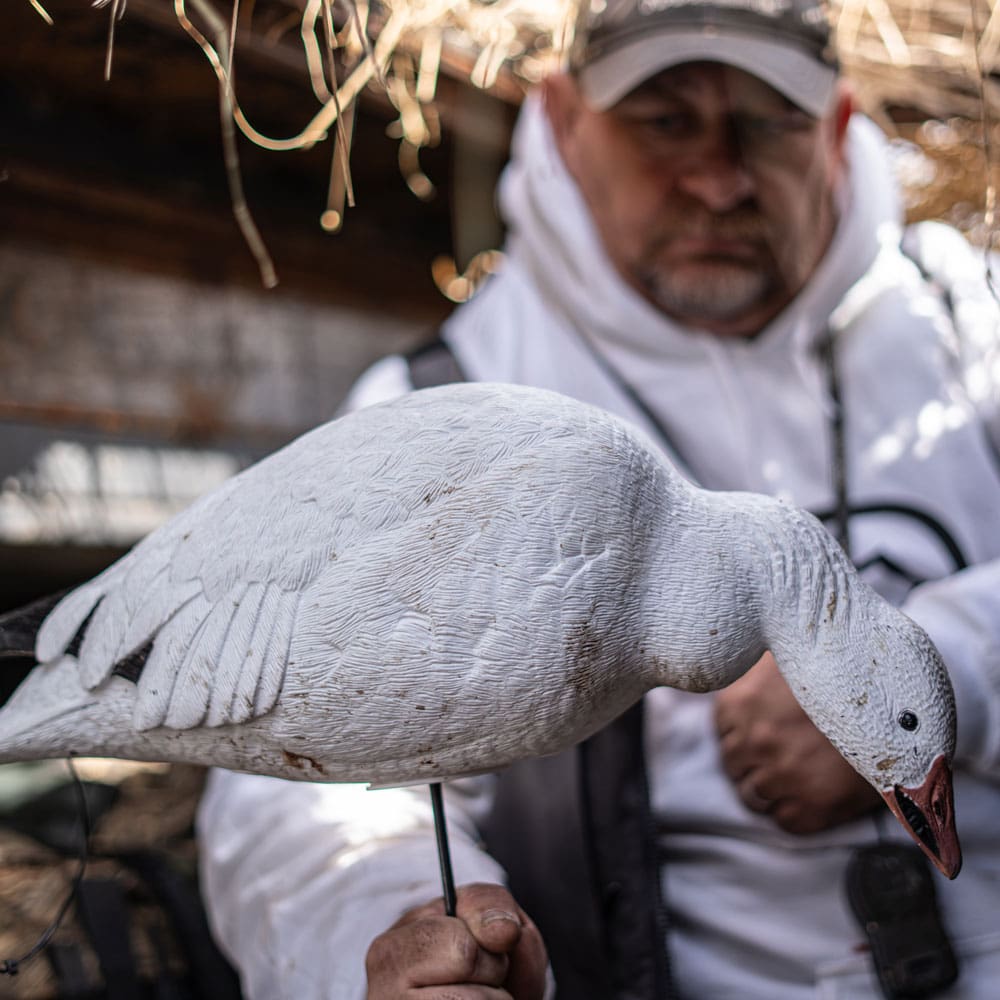
Get a single Snow full body for $24.99 with free shipping. Look at the paint, flex it, set it on its stake in a light wind. Then buy the spread.
Singles come out of full packs, so the pose is a random pick.
Why Hardcore
A snow spread takes a beating. Hundreds of decoys go out before daylight, come back in by noon, and ride a trailer to the next field, day after day for months. Ours are built for that, and built to look like real birds while it happens.
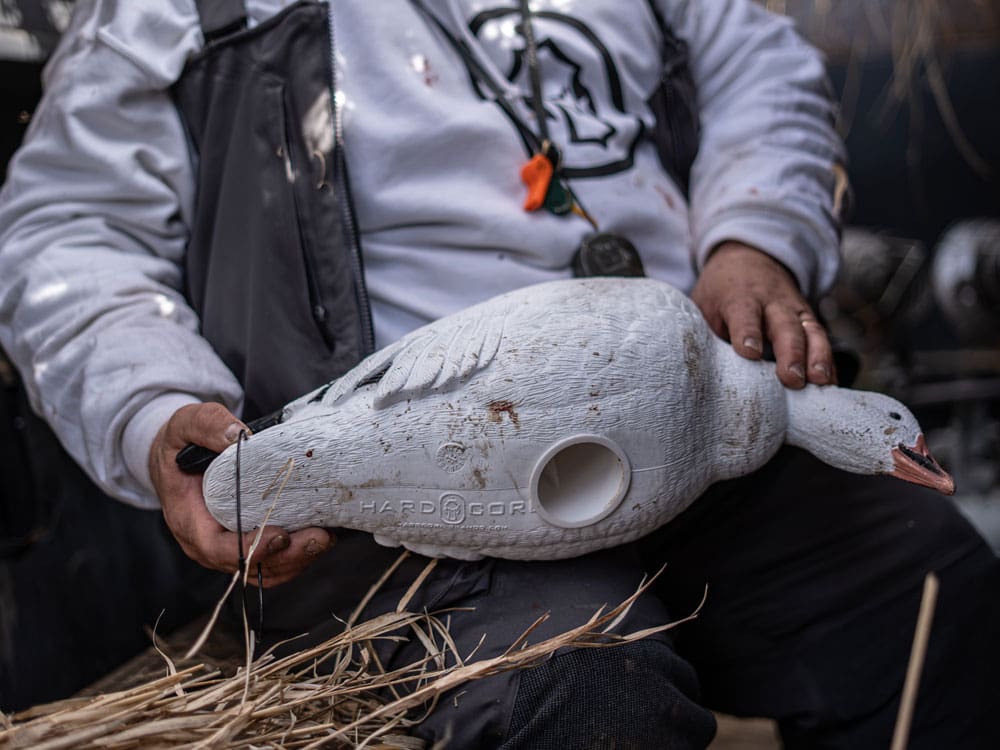
Every snow decoy we sell
Built into every Rugged Series decoy, and every snow decoy we sell is Rugged Series. It takes the impact instead of cracking, so full bodies and floaters hold up to trailer loads, frozen fields and getting stepped on in the dark. They're virtually indestructible.
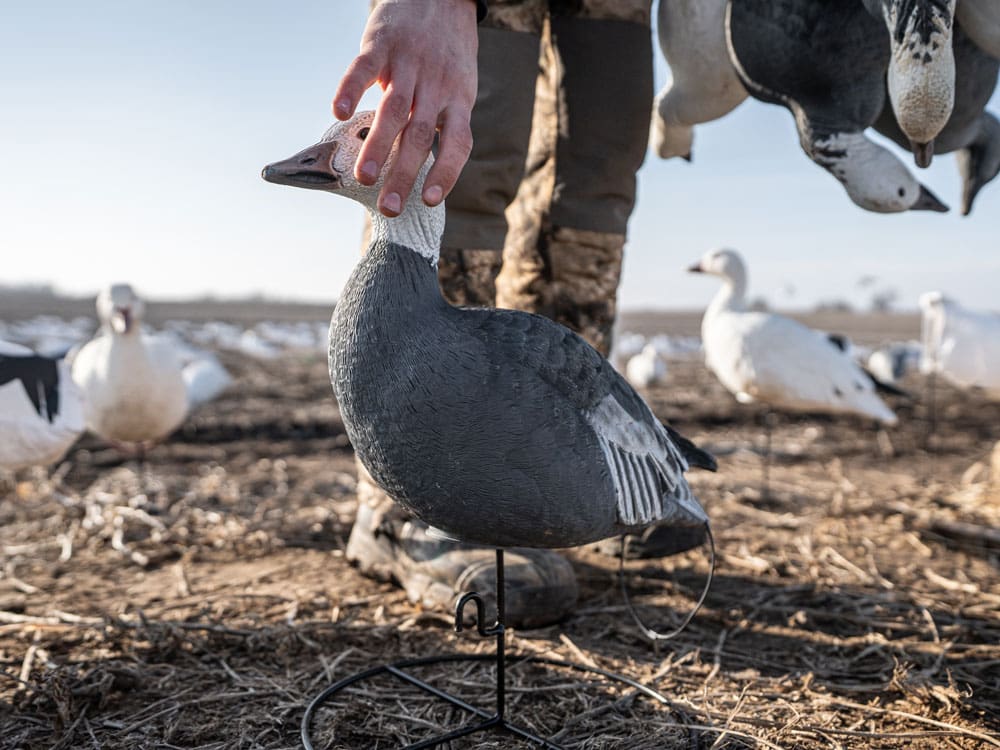
Every full body 12-pack
A field stake system that catches the slightest breeze, so full bodies sway and pivot like birds feeding. Every full body 12-pack comes with the stakes, a 12" base and 20" tall, so there's nothing extra to buy or haul.
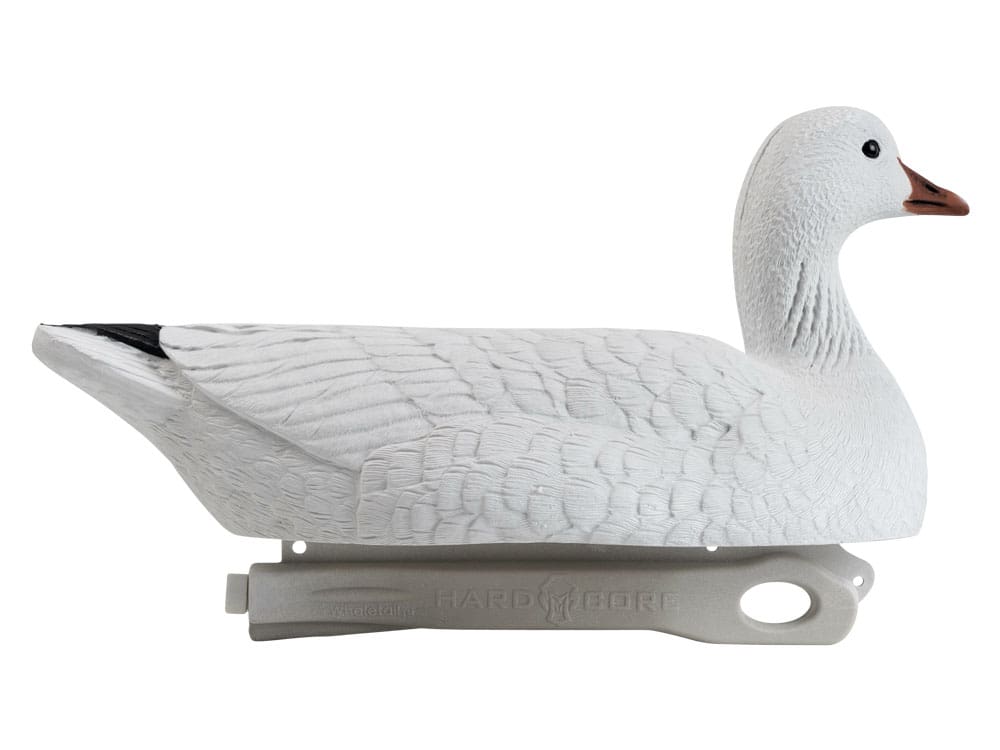
Snow Goose Floaters
Creates subtle, lifelike movement with minimal current or light wind, so floaters on a staging pond or sheet water don't sit parked.
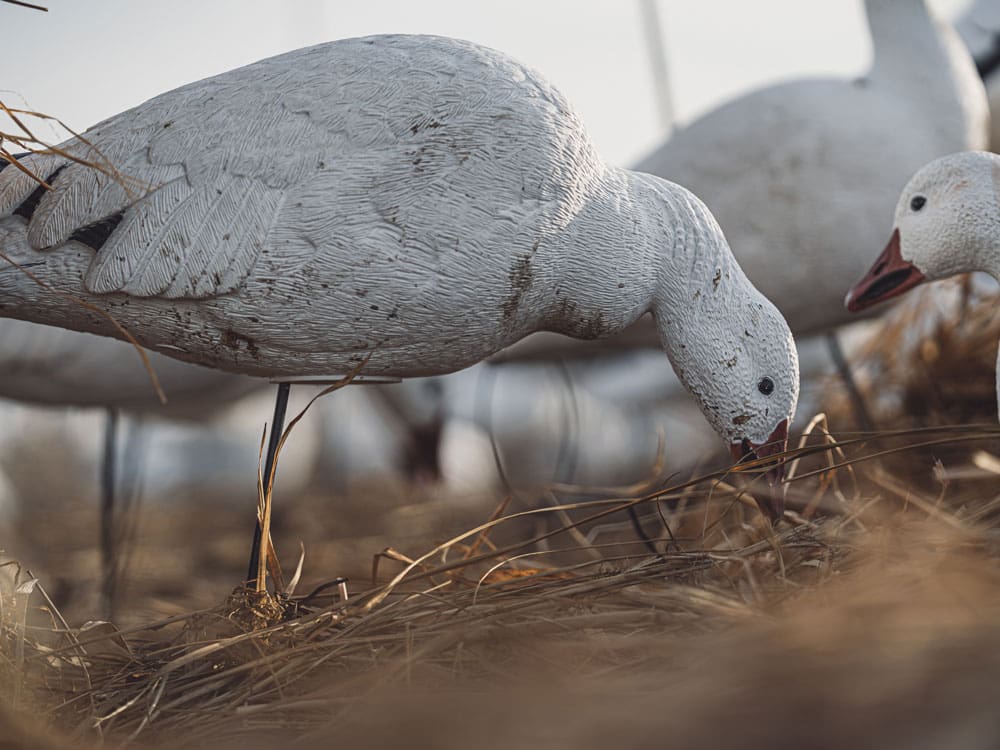
Every snow and blue full body
True-to-life adult and juvenile paint schemes, matched to the color, feather pattern and contrast of live birds. Every 12-pack mixes juveniles in, so your spread reads as families, not a flock of adults.
Watch: FowlFlex™ technology
The lineup
Two full body 12-packs, a floater 6-pack for the water, and a single so you can try one first. All Rugged Series, all FowlFlex™.
Finish the rig
Hundreds of full bodies have to get to the field somehow, and floaters need rigging that holds when the wind picks up.
6-Slot Goose Decoy Bag
Holds snow full bodies. Mesh bottom drains. ★ 4.7 (29)
$59.99
Mesh Decoy Bag
Stakes, floaters and extras
from $10.79
Texas Rig 36", 4 oz
Floaters on shallow sheet water
$34.99
Texas Rig 48", 6 oz
Deeper water and wind
$39.99
EZ Hook Weights 12-Pack, 4 oz
Swap weights fast
$29.99
Braided Decoy Cord
Rig your own
from $7.49
Buying a full spread
Snow spreads run big, so bulk pricing is standing, not a sale. It applies per pack model: the quantity has to be the same 12-pack, not a mixed cart. Guides and outfitters running more than one spread should start with the Outfitters Program.
Not sure yet? Buy one.
The Snow full body single is $24.99 and ships free. See the paint and the FowlFlex™ build for yourself before you buy the spread.
Pay in 4
Pricing out a big spread? Split the order into 4 payments with Afterpay or PayPal at checkout.
Free shipping on orders over $399, Continental US only. One promo code per order, no stacking.
Example: Full Body Snow and Blue Goose Touchdown 12-Pack, $279.99
Packs
Full bodies
Per pack
Per decoy
Save
1 to 9
12 to 108
$279.99
$23.33
-
10 to 19
120 to 228
$251.99
$21.00
10%
20 or more
240 or more
$223.99
$18.67
20%
From the field
105
reviews
★ 4.8 average
Across both snow full body 12-packs
4.8
(56)
★ out of 5
Snow Touchdown 12-Pack
4.8
(49)
★ out of 5
Snow and Blue Touchdown 12-Pack
4.7
(3)
★ out of 5
Snow Goose Floater 6-Pack
4.5
(2)
★ out of 5
Snow Full Body Single
FAQ
There are two parts to it. Fall seasons run with the regular waterfowl season, and in states that take part, the spring Light Goose Conservation Order runs from late winter into spring. Dates, zones and permits are set state by state and change every year, and not every state takes part. Texas withdrew from the Conservation Order in 2024. Check your state wildlife agency's current regulations before you hunt.
It's a spring hunt that started in 1999 to bring down light goose numbers that were damaging Arctic breeding habitat. It covers lesser snow geese, including the blue phase, and Ross's geese. In most states that take part, it allows electronic calls and unplugged shotguns, has no daily bag limit, and extends shooting hours to a half hour after sunset. Some states require a separate permit, and the rules vary, so check yours.
It depends on the birds and how many people are setting. Big spring spreads can run 700 to 800 full bodies. In the fall, 250 to 300 full bodies spaced loose in the flight line can work. When birds get spooky, three to six dozen realistic decoys can beat a big spread. Start with what your crew can set and pull before daylight, and add packs from there.
Yes. Spring snows have gotten more decoy-shy, and one Missouri outfitter now runs 700 to 800 full bodies on motion stakes because of it. Full bodies give you the realism up close, and TruMotion™ 2.0 stakes give you the motion.
Match the birds where you hunt. Mississippi and Central Flyway flocks carry blue-phase birds, so the Snow and Blue 12-pack, with 3 blues per pack, fits there. In the Atlantic Flyway, few blue-phase birds show up, so stick with the snow-only pack.
Upwind. Snows want the front of the feeding line, so incoming birds land upwind of the flock. Hide at the upwind end with an open landing zone in front of you, about 30 yards across. Wear white, cover your face and stay low.
Juveniles decoy a lot easier than adults. Ducks Unlimited reports the midcontinent population has produced fewer young over the last decade, though production bounced back in 2023 and 2024, when juveniles made up 20 to 30% of fall birds surveyed in Prairie Canada. Every Hardcore snow 12-pack includes juvenile paint schemes, so your spread looks like families.
Every snow decoy we sell is Rugged Series, built with FowlFlex™ for impact resistance in harsh conditions and heavy use. They're one-piece poses, and they're virtually indestructible.
Yes. 10 or more of the same 12-pack takes 10% off, and 20 or more of the same 12-pack takes 20% off. It applies per pack model, not to a mixed cart. Guides and outfitters should look at the Outfitters Program.
Yes. The Snow full body single is $24.99 and ships free. Singles are pulled from full packs, so the pose and paint scheme are a random pick.
#HuntHardCore
Snows pay off for the hunters who scout the feed, hide in the open and set a spread that looks like real families feeding. Start with a core of Rugged Series full bodies and build on it every season.